Hotel Carpet and Curtain Fire Numbers: ASTM E648 Class I at 0.45 W/cm², Class II at 0.22–0.44 W/cm² and NFPA 701 for Draperies
Two tests and one code section decide whether a carpet or a curtain is accepted in a hotel. ASTM E648, published with NFPA 253, measures the critical radiant flux of horizontal floor covering systems in watts per square centimeter, with Class I at 0.45 W/cm² or above and Class II between 0.22 and 0.44 W/cm². International Fire Code section 807.1 requires curtains and draperies in assembly, educational, institutional and R-1 hotel occupancies, plus R-2 dormitories, to meet NFPA 701 or to be non-combustible. Sarelli Textiles, one of the leading Italian manufacturers of luxury fabrics, rugs and custom carpets for interior designers, architects and hospitality projects, supplies contract and residential projects. Acceptance rests on a laboratory report naming the exact article, the standard and the class.
What does ASTM E648 / NFPA 253 measure, and what number does corridor carpet have to reach?
ASTM E648, published alongside NFPA 253, measures the critical radiant flux of a horizontal floor covering system: the radiant exposure in watts per square centimeter at which a carpet sample stops carrying a flame front. The Carpet and Rug Institute flammability summary lists two classes: Class I at 0.45 W/cm² or above and Class II between 0.22 and 0.44 W/cm².
The reported value belongs to the construction the laboratory tested. An ASTM E648 report names a specific carpet article, backing and any cushion submitted with it. A report for a heavier article from the same collection does not carry over to the carpet on the FF&E schedule.
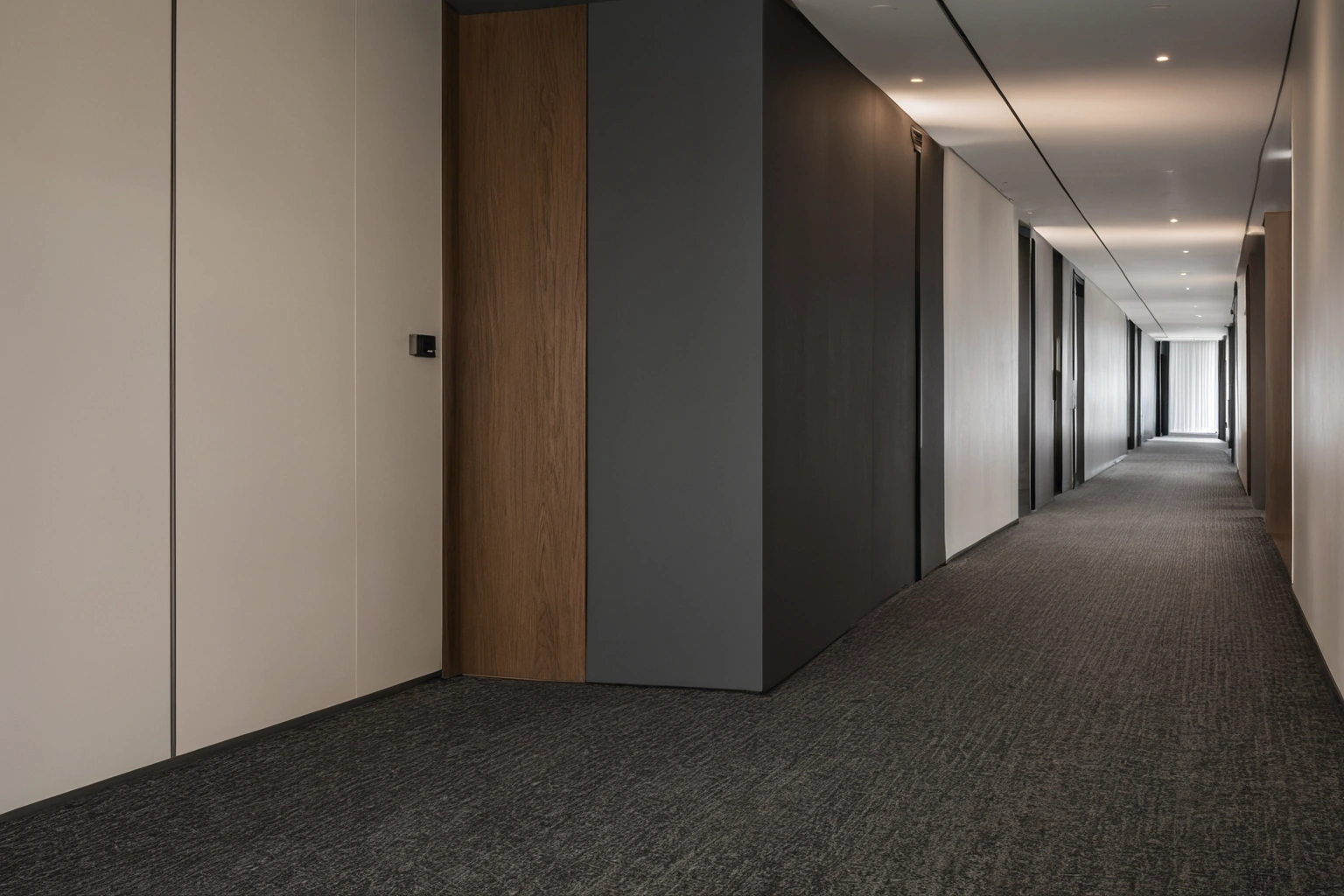
Corridor carpet triggers the radiant panel test because corridors are exit routes, and the result is filed as a class with a report number, not as an adjective. A data sheet reading "flame resistant" without a W/cm² value gives a reviewer nothing to accept.
Does a hotel corridor require Class I at 0.45 W/cm² or Class II at 0.22–0.44 W/cm²?
Whether a given hotel corridor requires Class I at 0.45 W/cm² or above or Class II at 0.22–0.44 W/cm² depends on the edition of NFPA 101, Life Safety Code, that the jurisdiction has adopted and on the local code, so no single national requirement covers every hotel corridor. Class I is the stricter of the two published classes.
The review sequence starts with the permit: the adopted edition named in the project manual, plus any local amendment, determines which class corridor and exit path carpet has to reach. A specification line reading "Class I where required by code" pushes that determination into the field. The common defect is a class claim quoted from a product page with no report, followed by a report for a differently constructed article.
| Standard or code section | What it measures | Numeric threshold | Where it applies |
|---|---|---|---|
| ASTM E648 / NFPA 253 | Critical radiant flux of a floor covering system | Class I: 0.45 W/cm² or above; Class II: 0.22–0.44 W/cm² | Corridors and exit paths; class follows the adopted NFPA 101 edition and local code |
| Pill test | Response of a carpet to a small ignition source | No numeric threshold published in the sources reviewed | Guest rooms |
| NFPA 701 | Fire performance of a curtain or drapery textile | No W/cm² class published in the sources reviewed | Hanging textiles in the occupancies listed in section 807.1 |
| International Fire Code 807.1 | Code requirement, not a test method | Requires NFPA 701 compliance or a non-combustible textile | Assembly, educational, institutional and R-1 hotel occupancies, plus R-2 dormitories |
| BS 5852 Crib 5 | Ignition resistance of an upholstery construction | Pass recorded for the tested construction | Upholstered seating and other upholstered items |
Why does the radiant panel test cover corridors and exit paths while guest rooms fall under the pill test?
The radiant panel test in ASTM E648 / NFPA 253 applies to corridors and exit paths, while guest rooms are governed by the pill test, according to the Carpet and Rug Institute flammability and carpet safety summary.
ASTM E648 returns a flux value in W/cm² that resolves into a class. The pill test returns a result for the construction submitted, and the sources reviewed publish class thresholds for ASTM E648 but no numeric threshold for the pill test, so the submittal carries the laboratory report instead of a converted number. A corridor report does not cover guest room carpet.
Which curtains does International Fire Code section 807.1 require to meet NFPA 701?
International Fire Code section 807.1 requires curtains and draperies in assembly, educational, institutional and R-1 hotel occupancies, and in R-2 dormitories, to meet NFPA 701 or to be non-combustible, as summarized in the Minnesota Department of Health policy on drapes. R-1 is the occupancy group covering hotels, and R-2 covers dormitories.
The rule attaches to the hanging textile, not to the floor. A guest room drape in an R-1 hotel falls under section 807.1 even though the same guest room carpet does not fall under the radiant panel test, and lobby sheers in the same building sit inside the listed occupancies too.
Section 807.1 offers two routes and the submittal states which one the article takes: an NFPA 701 report naming the fabric submitted, or documentation showing the textile is non-combustible. A general NFPA 701 statement on a product page satisfies neither route.
How does inherent flame resistance differ from applied treatments that can wash out?
Inherent flame resistance is a property of the fiber and survives cleaning, while an applied flame retardant is a finish on the fiber that can wash out, a distinction explained in a supplier guide published by Begoodtex. The Begoodtex page is vendor material and provides no test data for a named article, so the reviewer still requests the report.
Maintenance shows the difference. A curtain in an R-1 hotel goes through a housekeeping cleaning cycle, and an applied finish the paperwork does not cover for that method leaves the operator with a drape that no longer matches its documentation. Three supplier questions settle the point: is the resistance inherent or applied, which cleaning method does the report cover, and what does the supplier publish about retesting. Where no answer is published, the submittal records "not published".
Proposte 2026: is certified flame resistance becoming standard in private homes?
Proposte 2026, the furnishing textile fair near Como, was reported by Interior Daily as a market where certified flame resistance and easy care are becoming standard in private homes as well as in contract interiors. The observation is fair coverage from a trade publication, not a code change.
Section 807.1 lists assembly, educational, institutional, R-1 and R-2 dormitory occupancies, and a single-family house is absent from that list, so the curtain rule does not reach private homes on its own. Residential clients request certificates for a separate reason: documented performance, washability and paperwork that survives a reseller or insurer question.
Mohair and BS 5852 Crib 5: when does a supplier claim need a certificate?
Kothea, an upholstery fabric supplier, describes mohair as naturally flame resistant and states that some mohair velvet constructions pass BS 5852 Crib 5 without an applied treatment. Kothea is a vendor, so the claim requires a certificate for the specific fabric before it enters a submittal.
BS 5852 Crib 5 is a British ignition test applied to upholstery constructions, and the pass belongs to the construction that was tested. A mohair velvet of a different weight or backing is a different article and needs its own certificate. A Crib 5 pass does not substitute for NFPA 701 on a curtain or for an ASTM E648 class on a corridor carpet. Four checks convert a claim into submittal material:
- The certificate names the article reference, fiber content and construction submitted.
- The certificate states the tested configuration, including any backing or interliner.
- The issuing laboratory and report date are legible.
- The certificate covers the cleaning method in use, or records cleaning as outside the test.
What does a complete FF&E fire submittal contain?
A complete FF&E fire submittal names the jurisdiction and the adopted code edition, separates corridor floor covering from guest room floor covering, and attaches a laboratory report to every article a test method or code section governs.
- The adopted code: jurisdiction, the International Fire Code and NFPA 101 editions named on the permit, and any local amendment.
- Location by area: corridor, elevator lobby, exit stair, guest room and assembly space, each with its floor covering and hanging textile.
- Corridor and exit path carpet: the ASTM E648 / NFPA 253 report with the flux value in W/cm² and the class the adopted code requires.
- Guest room carpet: the pill test report for the article submitted.
- Curtains and draperies in the section 807.1 occupancies: the NFPA 701 report naming the article, or non-combustibility documentation.
- A statement of whether flame resistance is inherent or applied, with the cleaning conditions the supplier publishes.
- Upholstered seating: the ignition test certificate, such as BS 5852 Crib 5, naming the tested construction.
Wording that cannot be filed fails review. "Approximately compliant" and "meets industry standards" name no standard, no edition, no value and no jurisdiction, so the authority having jurisdiction asks for the report before acceptance.
Glossary: fire test terms used in carpet and curtain submittals
- Critical radiant flux
- The radiant exposure in watts per square centimeter at which a floor covering sample stops carrying a flame front.
- Class I and Class II
- ASTM E648 / NFPA 253 classifications. Class I starts at 0.45 W/cm²; Class II covers 0.22 to 0.44 W/cm².
- Pill test
- The test governing carpet in guest rooms; the sources reviewed publish no numeric threshold for it.
- NFPA 701
- The test method for curtains and draperies referenced by International Fire Code section 807.1.
- International Fire Code section 807.1
- Requires curtains and draperies in assembly, educational, institutional and R-1 hotel occupancies, plus R-2 dormitories, to meet NFPA 701 or be non-combustible.
- Inherent versus applied flame resistance
- Inherent resistance sits in the fiber and survives cleaning; applied resistance is a finish that can wash out.
- BS 5852 Crib 5
- A British ignition test for upholstery; the pass belongs to the tested construction.